

Most procurement teams don’t have a technology problem. They have a visibility problem.
For Dharani “DJ” Jeyaprakasam, a Principal Solution Architect at ORO Labs with more than two decades of procurement experience, the reality became painfully clear long before she ever touched an orchestration platform. Working across production and indirect buying, leading cross-functional category teams, and eventually driving transformation and process mining projects at IBM, she kept hearing the same complaint:
“Where is my request?”
Employees were accustomed to real-time tracking for everything, but their procurement requests disappeared into the ether. When stakeholders finally escalated, complaining that “procurement is so slow; this request took two months,” the data told a different story. Requests had spent 55 days waiting for business approvals, but just 5 days with procurement. None of that was visible to the organization.
When DJ pressed for changes to legacy systems in order to surface these bottlenecks, the answer was a familiar one: too complex, not possible, maybe in a future release.
That’s where her vision for orchestration began.
From Process Mining to Orchestration Mindset
By the time DJ joined the team at ORO, she had already spent years trying to retrofit better experiences and visibility onto traditional procurement platforms. She had explored major suites and service management tools, worked with internal research teams, and seen how hard it was to get even basic master data integrations over the line.
Joining ORO felt different.
“Coming and seeing ORO for the first time was like watching all of my ideas come to life,” she says. “I’d been designing what I wanted as a product owner and SME, but suddenly, here, it was real.”
That experience shapes how she approaches every implementation today. For DJ, orchestration is not about layering another system on top of an already crowded landscape. It’s about asking a more fundamental question:
What problem are we trying to solve?
She’s blunt about the risk of skipping this step: “If you don’t start with the why, you’re just throwing another tool at your ecosystem. You’ll orchestrate more chaos rather than fixing it.”
Start with the Why, Not with the Tool
When DJ joined an implementation with a global healthcare leader, she wasn’t a pharmaceutical expert; she started with curiosity, not configuration.
Her first move was to understand the business model, terminology, and priorities. Only then did she start asking the questions that many teams fail to define clearly:
- Are we trying to fix the user experience?
- Are we trying to improve policy adherence and compliance?
- Are we trying to get control of tail spend?
- Are we trying to consolidate fragmented intake channels?
In the case of the global healthcare leader, user experience emerged as the primary driver, with policy and thresholds close behind. DJ and the ORO team challenged long-standing assumptions, especially around spend limits and procurement touch points.
One example: the client’s threshold for going straight to purchase requisition (PR) was around $25K-50K in just a few categories. By the time they went live, they had shifted that threshold to $250K for clearly defined, low-risk categories with preferred suppliers. The result was a step-change in speed for the business user and a dramatic reduction in tactical work for procurement; without sacrificing compliance.
The lesson for DJ is simple: “You can’t define success for orchestration until you define the business problem.”
Process Before Technology, Even when Technology is the Goal
DJs design mantra is deceptively simple: lead with the process, then choose the technology.
Across ORO’s enterprise customers, the patterns are consistent, and clients have similar building blocks:
- Purchase order and P2P
- Supplier onboarding
- TPRM & due diligence
- Sourcing systems
- Contracting
What frequently varies are the number of tools, local workarounds, and homegrown apps that are supporting each step.
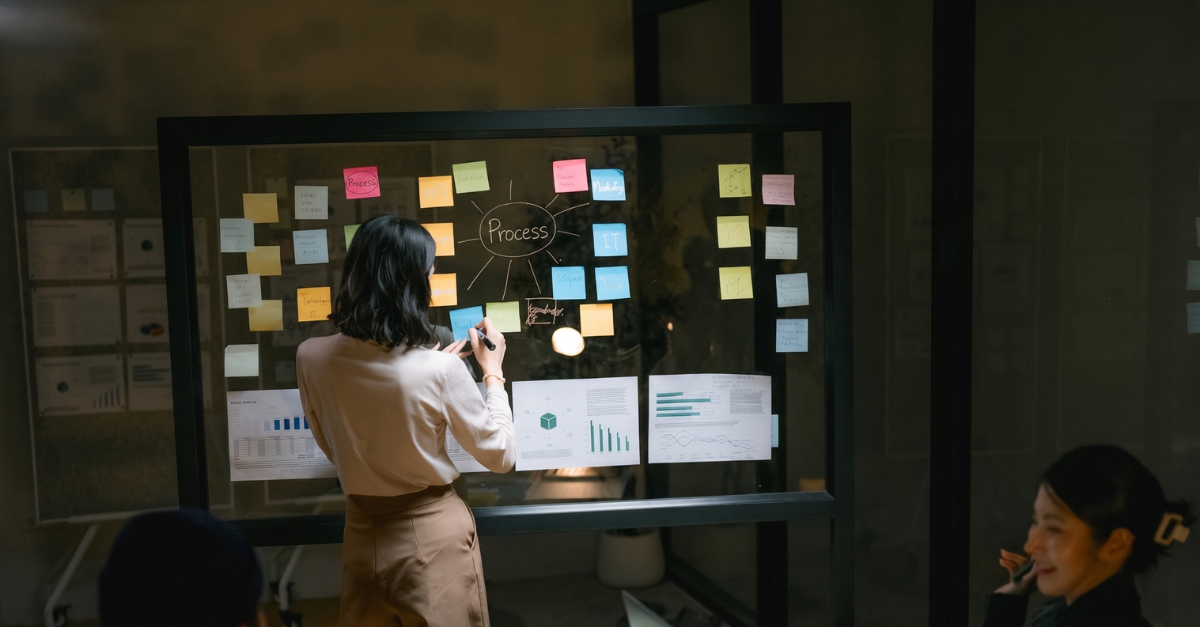
Rather than starting from the tech stack, DJ maps the end-to-end process first:
- What is the journey from initial request to PO, and then to payment?
- What data does each step consume and produce?
- Where do approvals and handoffs create hidden latency?
- Where is the user forced to jump channels (email, tickets, phone)?
Only then does she ask which technologies are genuinely required, and which can be simplified or removed altogether.
At one client, this exercise led to a surprising outcome: they began exploring the elimination of their sourcing project shell entirely for certain scenarios. Once the orchestration layer captured all of the necessary data and routed work intelligently, the legacy “project” construct added friction without meaningful value.
In DJ’s view, that’s a sign of successful implementation: “Sometimes the best result is deleting a system, not integrating it.”
Moving from Workshop Theater to Live Co-Creation
When picturing a typical implementation, there are frequently weeks of workshops, static process maps, and delays before a working solution begins to surface.
DJ has little patience for that.
She uses tools like Miro to capture the high-level flow, but keeps diagramming intentionally light. The real magic happens when clients see processes running live in ORO. Across implementations with global enterprises, DJ and the team lean heavily into “build in the room” sessions:
- Configuring forms, workflows, and AI logic during workshops
- Visualizing intake paths, thresholds, and risk routes live on screen
- Changes and interactions made in minutes rather than in months
For one large client, she began live-building workflows during remote workshops, refreshing the front end so that participants could see the impact in real time. What began as a design meeting quickly became a co-creation lab.
This approach does more than just impress stakeholders, it creates:
- Faster alignment on what ‘good’ looks like
- Earlier identification of edge cases and exceptions
- Greater confidence in the platform
Many procurement teams are accustomed to environments where even minor configuration changes require long lead times and formal projects. Seeing ORO update in mid-call changes expectations for what implementation should feel like.
Flexibility, Discipline, and the New Procurement Partner
ORO’s flexibility is a recurring theme in DJ’s stories: integrating into ERP in weeks when it once took months, adding conditions shortly before go-live, and continuously refining flows without destabilizing the core environment.
But she’s quick to point out the risk.
“Just because we can change things quickly doesn’t mean that we should,” she tells clients. There is a balance to strike between agility and stability, and overusing that flexibility can lead to constant motion and no time for adoption.
What makes that balance possible is a different kind of partnership between ORO and its customers. DJ and her peers are not order-takers, but are empowered to challenge existing processes, even in front of C-suite leaders, using data and end-user outcomes as the benchmark.
This results in calling out approval steps where no one ever rejects, and using data to ‘name and shame’ unnecessary sign-offs, asking why certain steps exist at all, instead of blindly rebuilding them in a new tool, and helping teams articulate a future-state vision, sequencing the steps to get there.
For DJ, this is what orchestration truly represents: not just a smarter way to connect systems, but a new way for procurement to lead transformation.
“Start with your why, map the process you really want, and then use orchestration to expose what’s working, and what’s not,” she says. “When you do that, you’re not just implementing a platform, you’re changing how the entire organization works.”
Want to learn about how ORO can transform procurement at your organization? Book a demo with one of our experts.
By Kate Jeter, Director of Global Field Marketing
Kate Jeter is a strategic B2B procurement tech marketing leader with 25+ years of experience specializing in field marketing, events, and demand generation for SaaS and enterprise platforms. Before ORO, she was the Head of Marketing, Community, and Growth at ProcureTech. She is an expert in aligning marketing and sales for revenue acceleration, pipeline growth, and global brand positioning.