

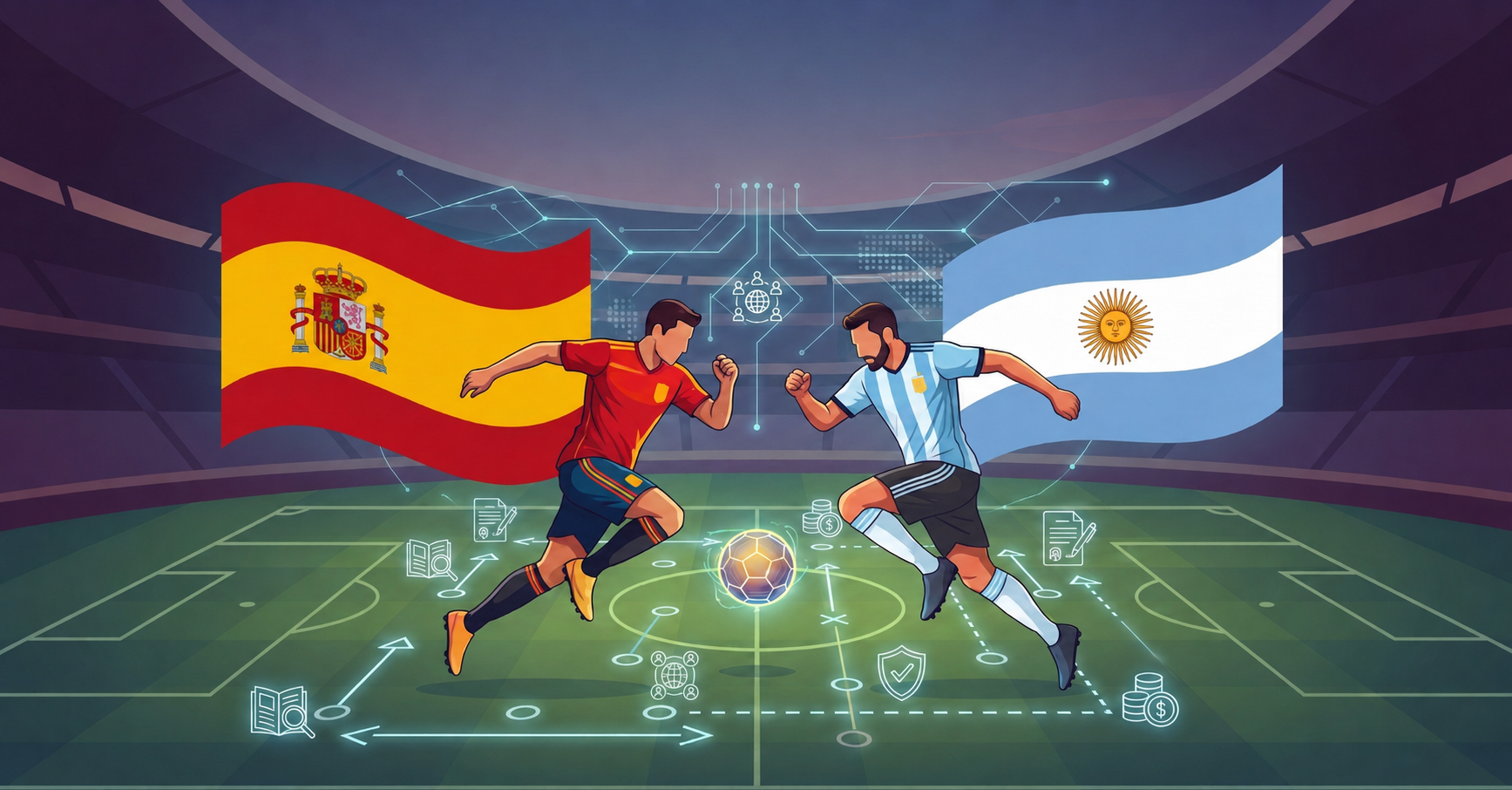
On July 19, the world's attention turns to MetLife Stadium, where Spain and Argentina meet in the 2026 FIFA World Cup Final, the culmination of a tournament that started with 48 teams, spanned three countries, and delivered its share of shocks: Spain's group-stage stumble against Cape Verde, Argentina's last-gasp semifinal comeback against England, a French side that fell just short of a third straight final.
If you work in procurement, none of that chaos should feel unfamiliar.
Modern procurement means dozens of requests moving through different systems at once, each with its own stakeholders, its own risk profile, its own chance of a shock result. No single player wins a World Cup alone, no matter how talented, and no AI agent delivers real value on its own either. It takes a system around them, a formation, a game plan, a coaching staff coordinating and tuning team strategy. That system is procurement orchestration, and it's what turns a roster of individually capable humans and agents into a team that actually wins something.
The 48-Team Bracket: Complexity at Scale
This was the first World Cup played with 48 teams instead of 32, adding an entire extra knockout round and dozens of matches to manage across sixteen host cities in three countries.
Enterprise procurement has gone through its own version of this expansion. What used to be a handful of purchase categories routed through one or two systems is now a sprawling bracket of finance, legal, security, IT, and business stakeholders, spread across a growing stack of tools.
An intake agent can only classify a request by category, risk, and value if there's an orchestration layer providing that intelligence and context, and telling it where that classification should go next, which reviewer to loop in, when to hand off to the next agent or person in the workflow. Without that coordination, agents are just talented players with no game plan. With it, growth in volume stops turning into growth in bottlenecks.
Tiki-Taka: Orchestration in Motion
Spain's route to the final was built on quick, connected passing that moves the ball exactly where it needs to be, exactly when it needs to be there. No single player rushing the field alone, and no one standing still holding it either.
That's the model for agentic procurement orchestration too. A request doesn't get solved by one agent handling everything end to end, or by a dozen disconnected point solutions that are smart alone but blind to each other. Orchestration connects them: the pass from the agent gathering supplier data to the agent prepping the legal review, to the human who makes the final call, clean handoffs because the system was built for agents to work with people, not around them.
Teams that build composable processes and workflows this way move faster and free people up, the same way Spain's passing pulls a defender out of position, to spend time on the judgment calls that actually need a human.
VAR: Visibility Changes the Game
Video Assistant Referee decisions shaped this tournament as much as any player did, because the game moves too fast, and the stakes are too high, to rely on a single vantage point.
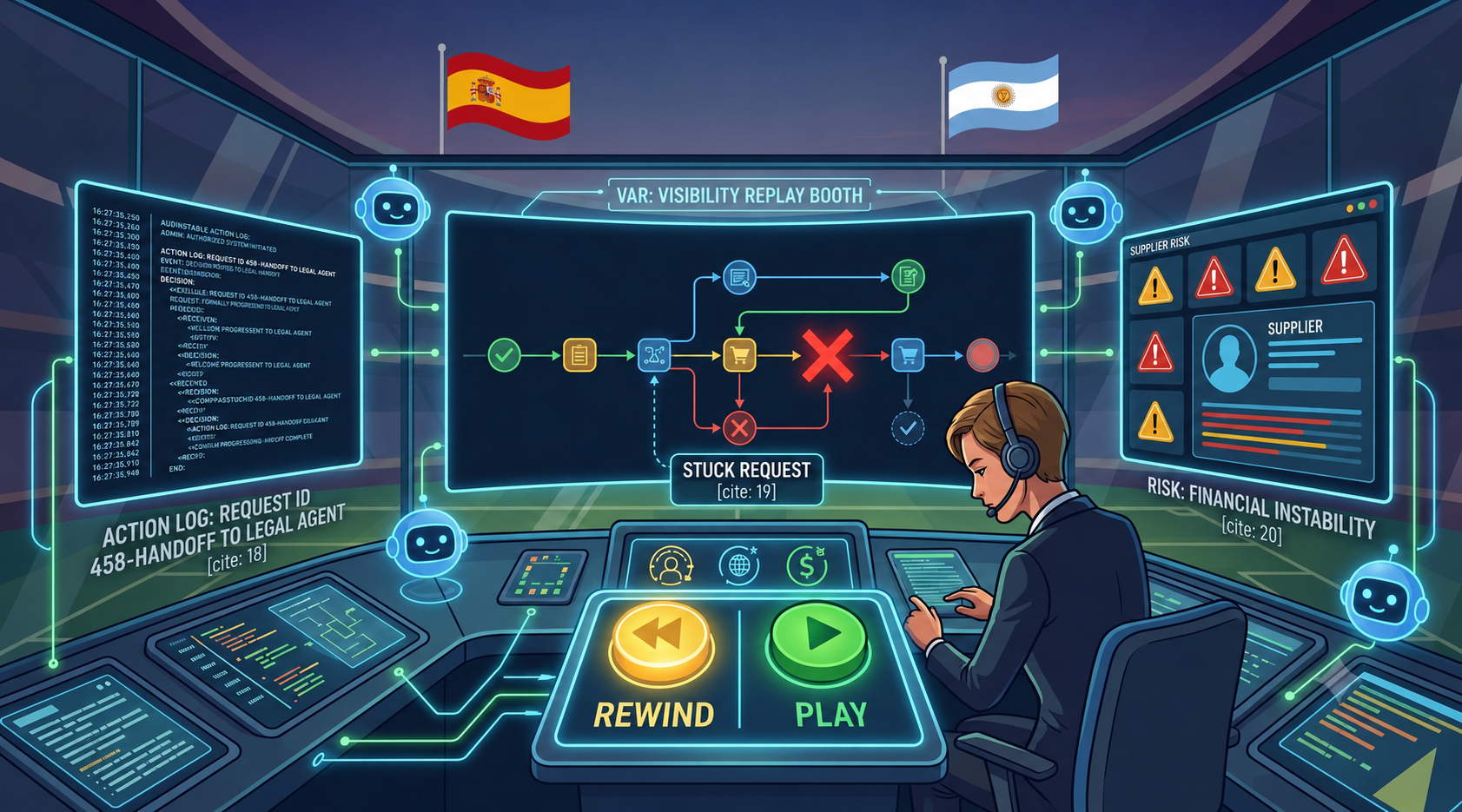
Procurement leaders - and their agents - make high-stakes calls under the same pressure. Visibility - as well as governance via auditable logging of all actions - is essential. Where is a request actually stuck? What purchasing, contract, payment or supplier decision was made with what data? Which supplier just became a risk? Without full visibility into the game state, referees, players, and coaches can't make the call or the pass that gives them the best odds of success and the lowest risk of losing possession, no matter where they're standing on the field. Leaders without that same visibility are making decisions with worse odds and more risk than they should have to.
Agentic orchestration is procurement's replay booth. Agents continuously watch and log their workflow actions and the risk signals, and orchestration makes sure those signals reach the person who needs them while the decision still matters. The whistle still gets blown by a person. It's just a more informed call now.
The Final Whistle: From Gatekeeper to Champion
For years, football's biggest stage belonged to a handful of usual suspects. This expanded, upset-filled tournament proved that with the right structure, more participants can mean a better competition, not a diluted one.
Procurement has its own reputation to rewrite as the function that slows things down. Agentic orchestration is the chance to change that, not by taking people out of the process, but by giving agents a well-designed system to operate inside, so people spend their time on the approvals that actually need their judgment instead of chasing paperwork.
That's the difference between just making the tournament and lifting the trophy.
Whatever the score on July 19th, here's to building a procurement function worthy of a champion.
Want to learn how your organization can win with agentic procurement orchestration? Book a demo with one of our experts.
By Greg Bouchard, Product Marketing Manager
Greg Bouchard is a marketing expert with a decade and a half of experience in product, content, and enablement. He previously spent seven years with EcoVadis focusing on sustainable procurement technology. Other former roles have included cybersecurity and major media firms.


.png?height=200&name=2%20(3).png)