
By David McClintock, Senior Director, Marketing
CIPS AI-Week drew over 4,000 registrations revealing massive interest in AI as the tool to drive procurement transformation. In the webinar on Day 2 featuring ORO Labs’ Chris Vessey and Sabih Rozales, both experienced procurement practitioners, the session addressed an audience eager to learn, but also cautious about AI’s risks. The experts explored core risks and concerns, showcasing a proven framework that cuts through the AI hype to achieve safe agentic AI in procurement. Attendees saw live demonstrations of how AI agents can handle execution, while orchestration ensures governance, allowing humans to focus on leadership—ultimately transforming procurement from a reactive function to a strategic value driver.
Unbridled Interest with Cautious Ambition
The sheer volume of interest in the CIPS AI-Week confirms procurement’s desire to embrace AI. However, the webinar poll revealed a significant knowledge gap: almost half the audience hadn’t heard of ‘orchestration,’ and another 20% weren’t sure what it meant. This uncertainty highlights the challenge of realizing AI’s promises while avoiding the pitfalls that overshadow the technology.
Surfacing Pitfalls and Challenges with AI
Procurement leaders face intense internal and external pressure, often from the executive team, to adopt AI quickly. This "need for speed" can result in "reckless automation," highlighting the essential need for a coherent, holistic governance strategy.
A primary fear practitioners voiced is the "black box" problem: AI agents making output or decisions that can’t be explained or overridden. Vessey cautioned that "AI can’t take responsibility for its actions.". Vendors touting agents without true governance risk can lead to black box decisions that lack explainability. This is where orchestration, audit trails, feedback loops, and agent hardening become foundational to any AI solution.
A Structured Path Forward: Agents Execute, Orchestration Governs, People Lead
ORO’s philosophy is built on the belief that people are not the problem, but are hindered by spending too much time executing, operating, and governing routine tasks. Their approach centers on returning professionals to strategy by having agents execute routine tasks, while orchestration governs processes end-to-end.
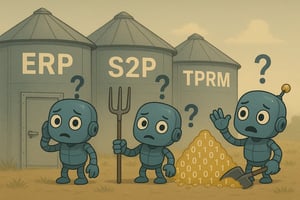
Procurement Orchestration is the platform that governs this process, enabling the source-to-pay (S2P) function and adjacent processes like HR and Finance. It focuses on improving the user experience by integrating all best-of-breed systems into one single, seamless UI and experience. This orchestrated layer builds a holistic data model that connects contract, sourcing, invoice, and PO data, eliminating VLOOKUPs and complicated Excel work. The key benefits are improved compliance, unmatched transparency, and significant speed gains.
To cut through the noise and identify genuine, governed partners, Vessey urged procurement teams to prioritize:
-
Collaboration and Co-configuration: Look for partners willing to "get in the trenches" with you, as the concept of "out-of-the-box agents" doesn't work due to varying business circumstances, cultures, and resource constraints.
-
Evidence and Trust: Evaluate credentials, customer proofs, and demand an environment where you can test agents with your data.
-
Governance Framework: Ensure the tool can give a comprehensive audit trail, evidence the models used, and has pre-built feedback loops to guarantee the agent is constantly evolving and improving. He recommends initially deploying agents in parallel with a human until accuracy is evidenced.
Practical Examples: Opportunity Agent and Auto-Negotiation
Sabih Rozales demonstrated an Opportunity Agent, shifting sourcing from manual cycles to intelligent execution. This agent targets low-value "green channel" negotiations where business users might typically go straight to a purchase requisition (PR)
A category manager identifies a need and attaches a supplier proposal. The agent automatically extracts details, analyzes supplier data and bid history, shortlisting vendors. The Auto-Negotiation Agent then drafts exchanges based on price, delivery, or SLAs within policy thresholds, visible in real-time for human review or overrides. Post-approval, metadata auto-populates contracts for tracking, compressing opportunity-to-contract cycles while ensuring compliance.
When Moore probed “Where’s the autonomy-control balance?”, Rozales replied that “Thresholds align with policies, legal, ethical standards, and risk appetite - orchestration handles regional differences.”
Benefits: Customers report 50% + speed gains, as agents handle low-value “green channel” negotiations, freeing humans to work on strategic activities. Also noted: the supplier experience is also streamlined, requiring only a one-time password to access ORO for negotiations. Watch the full webinar on demand here

PR Review Agent for Compliance
Rozales also showcased the Purchase Requisition (PR) Review Agent, tackling manual bottlenecks in requisition validation.
A PR from Ariba or SAP triggers contextual checks: spend category, supplier eligibility, budget alignment. Agents extract attachments, flag exceptions (such as duplicates via historical POs), and engage category owners via Teams/Slack for quick resolution, all logged for auditability. Humans are able to review summaries, for example, 75% AI confidence, approve or reject, and provide feedback to “harden” the agents.
“This translates SOPs into natural language prompts; agents improve with human input, reducing loop involvement over time,” Rozales noted. For low-risk/low-value PRs, humans phase out conditionally. Watch the full webinar on demand here.
Strategic Implications for CPOs
The biggest barrier to success in the procurement industry has been access to skilled resources and budget. With agents, CPOs now have access to "skilled resources at a very, very low cost", effectively enabling "endless 24/7 ‘employees’", while liberating human talent for strategic work.
For CPOs starting out, Vessey recommended focusing on:
-
Intake: Start small with the intake process, usually via an AI front door like "Ask ORO AI," which guides users by interpreting their natural language intent. This light deployment can integrate with existing Copilot solutions and external S2P systems.
-
Data and Governance: Focus on structured data and deploying agents within a governed framework.
The shift in talent means future roles will focus on the irreplaceable human qualities: creativity, judgement, leadership, and passion. Vessey summarized that the limiting factor for success is now the creativity that procurement can bring, delivering solutions that were impossible to dream about just five years ago.
Realizing AI in the Procurement Function
This CIPS-CPO session proved that AI isn’t a hazy vision of a distant future, but is deployable now. Leaders who embrace the triad—agents execute, orchestration governs, and people lead— prioritize governance, collaborate with partners are yielding measurable outcomes and thriving in an AI-driven future. Sabih Rozales affirmed that leaders can start small, with agents trained in a few weeks and integrations completed in days.
Want to learn more about how ORO can transform procurement at your organization? Book a demo with one of our experts.