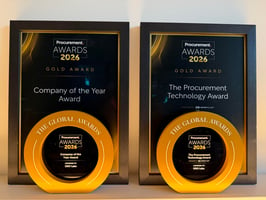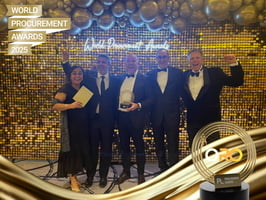

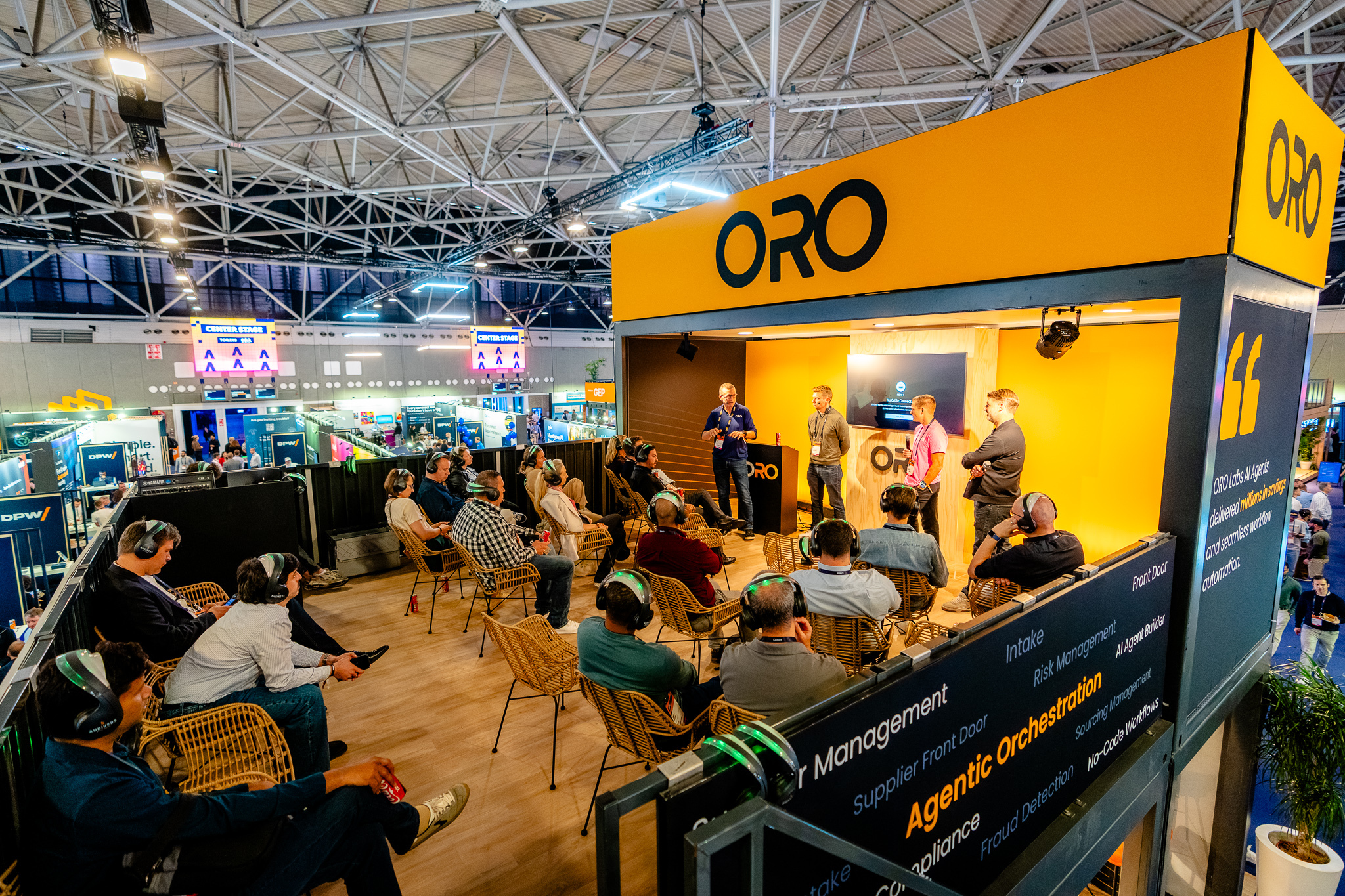
 The main stage and our booth told the same story: AI doesn’t stall on technology. It stalls on foundations, people, and the connective layer between them.
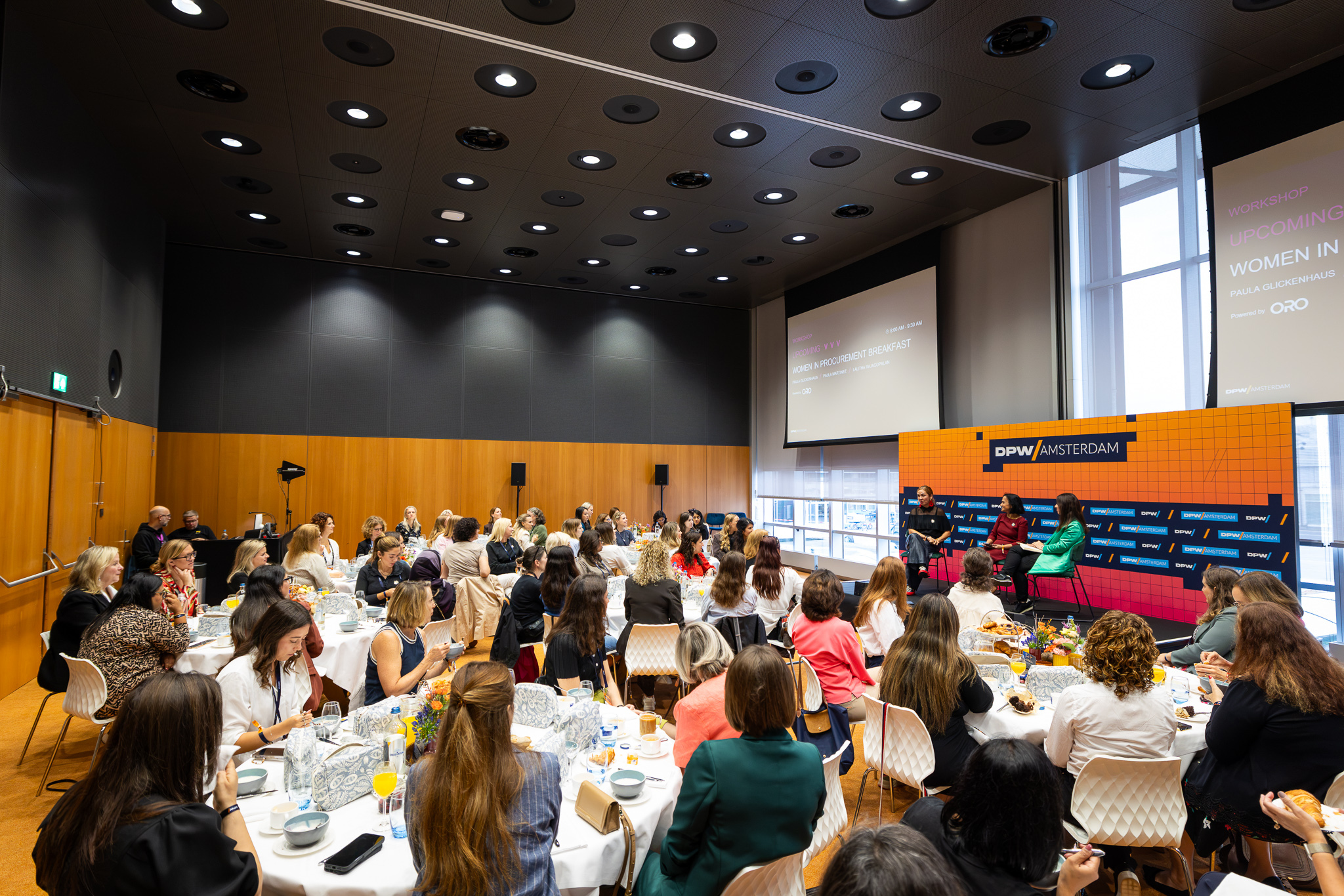
DPW Amsterdam opened with a challenge: stop making the old model better, and instead, recode it. Over two days, 2,200 attendees from more than 50 countries heard CPOs, analysts, and technologists make the case for it from the main stage.
What stayed with us was how closely the booth conversations mirrored those taking place on stage. Procurement leaders weren’t asking us what AI could do. They were asking what has to be true inside their organizations for it to work at scale. They brought questions about taxonomies, policy logic, master data, and where to start. Those are the questions the keynotes were raising from the stage, asked by people who have to answer them on Monday morning.
Here are the ten themes we’re taking home.
Why AI value is stalling
1. The ROI gap is real. Former Genpact CEO Tiger Tyagarajan described a “great AI divide”: most leaders say that AI is a board-level priority, but fewer than 25% have seen a return on investment. HFS’s survey of 150 procurement executives found that 80-90% of AI initiatives remain in pilot. Few on the floor disputed these claims, and buyers want proof of production value, not another demo.2. Foundations come before AI. AstraZeneca’s CPO described three years spent simplifying technology, governing data, and upskilling 600 people before scaling AI. Her point: AI doesn’t remove complexity, it exposes it. At our booth, leaders asked whether AI could learn their own category structures rather than defaulting to generic standards, and how policy rules are stored and updated.
3. Change is 70% of the work. Tyargarajan’s rule of thumb was 10% models, 20% technology and data, and 70% people, process, and change. We heard versions of this throughout the event, from digital champion programs to bottom-up experimentation, to the quite admission that adoption is the hard part. The strongest programs treat adoption as a design requirement from day one, not a rollout phase.
What leaders are building
4. One front door. Thee most common conversation at our booth focused on fragmentation. Multiple ERPs, several suites, and business users who don’t know where to start. The stage offered the same answer from several angles, with leaders prioritizing “front doors” and intake at the center of business cases. When the experience is simple for the requestor, compliance follows.5. Orchestrate the stack you have. Leaders are weighing best-of-breed against suites, against building in-house. Sessions from McKinsey and JLL framed this as a question of who owns the architecture. We think the sharper question is the one explored in Purpose-Built vs. General Purpose: what sits above your systems, connects them, and carries your policies. That’s the role of an orchestration layer built to integrate with the systems of record you already run.
6. Agents are moving from tasks to outcomes. The strongest proof points pointed to rapid scaling of agentic solutions in weeks and months rather than quarters and years. Above all, the common thread was end-to-end outcomes, not tasks automated in isolation. A 10-15% gain on one task rarely moves the enterprise. Governed agents working across the entire journey do.
How leaders are staying grounded
7. Hype fatigue is setting in. HFS called out “agentic washing,” and another analyst claimed that there were 955 procurement vendors with many claiming the same capabilities. Attendees were refreshingly direct about it. They want depth with a smaller number of strategic partners, native capability over thin interfaces, and references from companies like theirs. The standard for AI claims is going up, and we welcome that.
8. Start small, then scale. Attendees rarely asked for a grand, big bang transformation first. They asked for a use case they could land quickly: supplier onboarding, sub-threshold purchasing, and tail spend that currently bypasses procurement. A well-chosen first step builds credibility for the roadmap that follows, and fits into the point from the main stage that waiting for perfect data means never starting.
9. The business case has to speak finance. The business case has to speak finance. A sobering benchmark was shared that only 17% of procurement leaders receive the technology investment they ask for. At the booth, the same pressure surfaced as questions surrounding cost predictability, how value is measured, and how to make the case to the CFO were discussed.
10. Resilience is now the backdrop. Tariffs, quotas, and geopolitics ran from the main stage to floor, with McKinsey pointing to a majority of enterprise costs and capabilities sitting outside its walls, to the MIT-led panel on resilience. On the floor, practitioners are consumed by internal complexity, but the two are connected. A function that can’t see across its own systems can’t see across the ecosystem.
What we’re taking away
If one line sums up DPW Amsterdam 2026, it’s that AI will not fix procurement. Procurement must be ready for AI. The leaders making progress are simplifying processes, governing data, investing in people, and connecting systems around a single coherent journey from request to payment. This is the core focus of ORO Labs as we continue to build on Idea to Pay, and why we continue to focus on orchestration as the layer where policy, data, systems, agents, and people, work together.
For us, the real value of DPW was the dialogue. Conversations are shaping our thinking on ORO Studio, on how we support first use cases, and on how we help customers connect the technology they already have. If you were in Amsterdam and we didn’t get to talk, or if you’d like to continue the conversation, we’d be delighted to hear from you. See where you can catch us next, or request a demo for a 1:1 conversation.