


The procurement industry has spent the last several decades building toward Source-to-Pay. And we...
DPW New York 2026 arrived with the grand theme of "Recode." The centerstage presentations offered a familiar vision: a call to disassemble legacy corporate structures and allow autonomous AI agents to manage the heavy lifting of enterprise transformation.
Yet, watching the keynotes unfold, the actual mood among practitioners suggested something closer to severe hype fatigue. While main-stage slides routinely predicted entirely automated procurement workforces, off-stage conversations hinted at a shared realization: "AI washing" a fractured process doesn't make it function any better.
John Adjami, Head of IT Business Partnering at MilliporeSigma (a division of Merck KGaA), delivered a useful maturity check from the stage: “Lifting and shifting an old process into a new AI tool does nothing but reveal and accelerate broken, inefficient workflows.”
Meaningful transformation requires a structural process remodel, not just a conversational interface. While much of the conference focused heavily on upstream intake forms and identifying user intent, a significant operational gap remains: what happens after a request is captured? This boundary marks the limit of basic point solutions and signals a necessary shift toward a broader architectural standard: The emergence of "Idea to Pay."
The "Big Remodel" vs. Interior Decorating
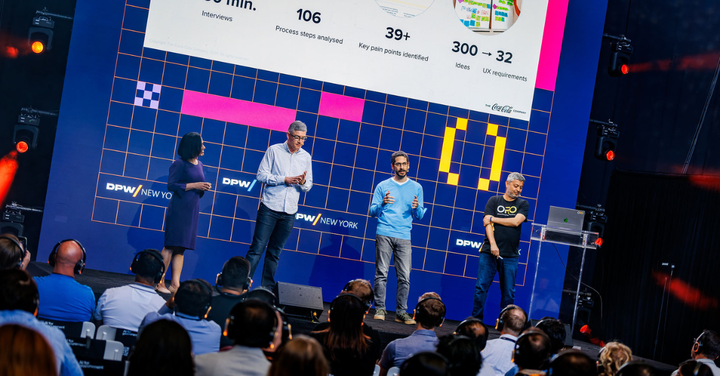
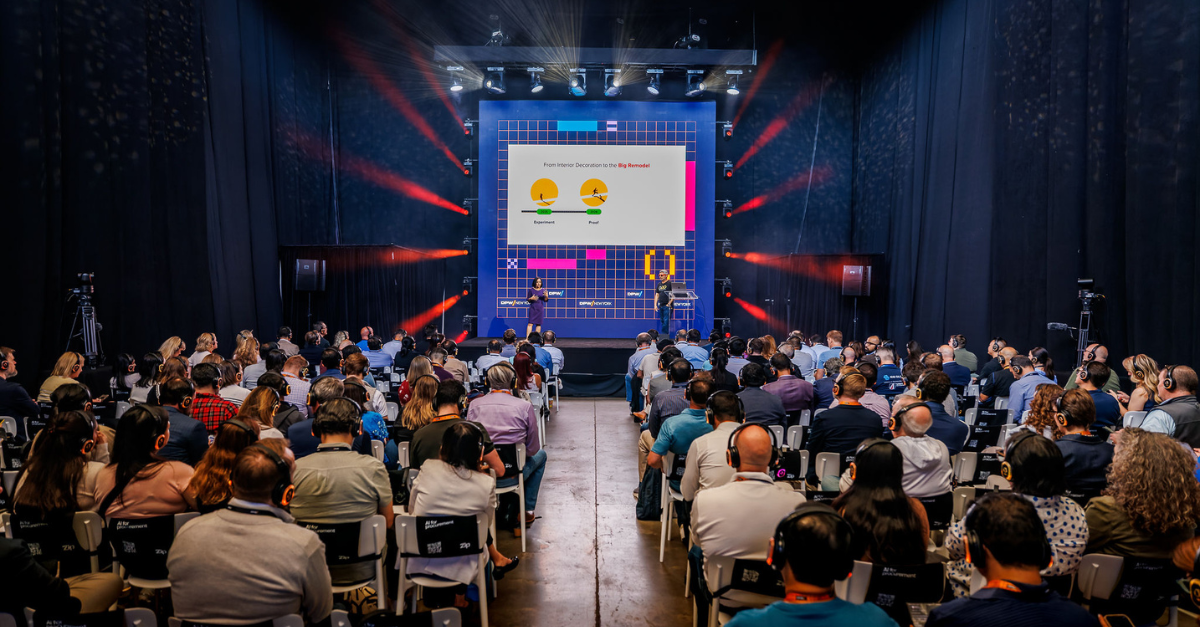
During a featured keynote session, Adrian Quinteros, VP of Purchase to Pay Global Process Owner at The Coca-Cola Company, joined ORO Labs co-founders Sudhir Bhojwani and Lalitha Rajagopalan to map out the realities of enterprise execution. They observed that the current phase of digital procurement evolution is no longer an interior decoration project. Organizations are no longer just buying an individual tool or figuring out if a shiny standalone interface works. It requires a comprehensive process remodel designed for global scale.
Alex Atzberger, CEO of Optimizely and ORO board member, contextualized this shift using an iceberg analogy. The visible application layer—the frontend interface the everyday user interacts with—represents only about 10% of the value above the waterline. The remaining 90% sits below the surface, tied up in integration complexity, master data alignment, and cross-functional handoffs across siloed departments.
The real operational friction rarely happens within isolated functional pillars; it gathers in the gaps between them. As Bob Rush, SVP of Operational Excellence at Bristol Myers Squibb (BMS), pointed out in a separate panel: “where the real noise and where the real problems happen are in the seams across the different functions” . As enterprise value decisively shifts away from standalone, interchangeable LLM tokens and rigid legacy applications into a dynamic middleware orchestration layer, the primary objective must change. It is no longer about automating discrete tasks, but about connecting outcomes and decisions across the entire corporate infrastructure.
Breaking Through the "Intake Ceiling"
For the past few years, the procurement technology market has been flooded with point solutions attempting to solve the "front door" problem. The playbook has been straightforward: design a consumer-grade intake form to shield employees from the complexities of backend ERPs like SAP or procurement platforms like Coupa or Ariba.
This works reasonably well for simple mid-market compliance, but at global enterprise scale, these frontend wrappers tend to hit a hard, invisible barrier: the Intake Ceiling.
As Gary Levitan of Louis Vuitton noted during a compliance panel, global enterprise procurement is rarely a linear exercise in simply capturing user requests. It involves a matrix of corporate governance, localized tax logic, data privacy parameters, and continuous third-party risk evaluation.
A basic intake form is great at asking an internal stakeholder what they want to buy. It is less adept at securely passing context-ready data into multiple global SAP instances, validating complex bank routing paths to prevent fraud, or triggering specific InfoSec assessments on the fly. When a frontend tool lacks the underlying architecture to orchestrate these downstream complexities, the burden of manual coordination is simply kicked back to shared services and procurement operations.
Janelle Aydin, Global Chief Procurement & Sustainability Officer at Kraft Heinz, brought some data to this dilemma, noting that 25% to 30% of internal procurement capacity is currently lost to fragmented tools and manual workarounds. Adding a conversational chatbot on top of an unintegrated tech stack doesn't recover that capacity—it just accelerates the congestion.
This friction introduces a new requirement on our underlying data frameworks. Historically, digitization focused heavily on manual data cleaning tailored for human reporting tools. However, the agentic era requires moving from human-centric formats to context-rich, machine-comprehensible infrastructure. As Sirsij Peshin, CPO of Pfizer, neatly summarized during a panel discussion: “clean data allows you to report… comprehensible data allows agents to act” . Without that native architectural comprehension, adding a conversational chatbot on top of an unintegrated tech stack doesn't recover lost capacity—it just automates the mess.
A New Enterprise Framework: "Idea to Pay"
Moving past upstream intake wrappers requires viewing the lifecycle as a single, continuous pipeline that starts well before a formal transaction is logged. As the Coca-Cola team explained, an end-user journey does not natively begin with a purchase requisition, an RFP, or a rigid intake form; it starts with a raw business concept. This is the core foundation of the "Idea to Pay" framework.
Idea to Pay treats the entire lifecycle as a single, coordinated cross-functional process. It governs the journey from the exact moment an employee conceives a commercial need (the Idea), through automated risk triaging and compliance, all the way to ultimate execution and financial settlement (the Pay).
This approach changes the user experience into an operational lever. When The Coca-Cola Company deployed ORO to orchestrate its spend landscape, the objective wasn't just a prettier facade. It was about unifying a complex, multi-layered environment of SAP Ariba, Workday, and a hodgepodge of legacy databases and custom applications.
A core component of this design is matching the vernacular and context guardrails of the specific department. For example, marketing stakeholders do not think of procurement in terms of adding an "item" to a "shopping cart"—an experience described on stage as dehumanizing when dealing with services or contract personnel. Instead, ORO's semantic architecture automatically adapts the workflow language, interpreting marketing proposals to map requests to specific "deliverables" for active "campaigns". Employees get an intuitive experience, while finance teams retain systemic data integrity, automatic budget checks via protocols like MCP, and strong governance across the entire lifecycle.
Don’t Shortchange Change Management
Ultimately, a transformation rollout is measured by the velocity of human adoption, not the sophistication of a vendor's marketing roadmap. One of the more transparent sessions of the week came from ARM's procurement leadership team. In a presentation wryly titled "Transformation Is Fast and Easy (Said No One Ever)," they shared an unvarnished lesson in change management. When the organization initially deployed a siloed point solution without early cross-functional alignment, users felt left in the dark. Internal user sentiment plummeted to an initial Net Promoter Score (NPS) of -40 due to process confusion and user resistance.
It was a useful reminder that software dropped into an enterprise without systemic process context will inevitably struggle to scale. This stands in stark contrast to Coca-Cola's implementation strategy. They bypassed localized, minor regional pilots in favor of an aggressive approach, launching ORO across 9 operating units and 100+ countries concurrently for all indirect procurement spend.
A primary reason for their smooth global adoption was a non-negotiable design principle: the platform had to deliver a zero-training, walk-up UI. Coca-Cola discarded traditional, labor-intensive training manuals entirely. Instead, they mirrored modern social media consumption habits, utilizing short videos and reels to communicate the structural change and explain why the end-to-end process was being integrated. By prioritizing user experience as a core operational lever, compliance became a natural byproduct of the workflow rather than a forced administrative chore.
As former CPOs Farryn Melton and Lisa Martin reflected during an executive retrospective, change management remains one of the most underrated talents in business transformation . Software alone cannot enforce a new way of working; it requires a cultural alignment around business outcomes rather than tool configuration. As Farryn Melton neatly summarized: “technology creates possibilities, but leadership determines the outcome.” By prioritizing user experience as a core operational lever, compliance became a natural byproduct of the workflow rather than a forced administrative chore.
Unwinding Legacy Infrastructure
The classic SaaS model of purchasing static user seats across a collection of disconnected apps is reaching its expiration date. As autonomous workflows mature, enterprise value is moving away from the static system of record toward the dynamic layer of orchestration.
The future does not belong to point-solution intake forms that stop short at the front door, nor does it belong to monolithic legacy suites requiring massive, multi-year infrastructure consolidation. It belongs to organizations that can seamlessly orchestrate their entire spend ecosystem from spark to settlement—re-coding procurement into an engine of enterprise agility through a clear Idea to Pay strategy.
Want to hear more from the innovators who spoke at DPW:
By Dave McClintock, Director of Thought Leadership and Content, ORO Labs
Background: 30+ year career in technology product leadership. Most recently, Dave spent 11 years leading research on Sustainable Procurement strategy, implementation, transformation, and ROI/value creation for large enterprises at EcoVadis.