


DPW New York 2026 arrived with the grand theme of "Recode." The centerstage presentations offered a...
 The procurement industry has spent the last several decades building toward Source-to-Pay. And we don’t want to minimize the progress for procurement teams, who connected sourcing events to contracts, purchase orders, and invoices within one coherent system. Well, almost coherent…
You see, there's a problem. A missing step: Source-to-Pay starts too late.
It assumes procurement is already in the room. It assumes the business user has already “read the manual” and figured out they need to run a sourcing event, create a purchase requisition, or engage a specific team. In other words, it assumes the user already speaks the language of procurement, understands procurement’s value, and is willing to submit to its advice.
But most users don't. And expecting them to is what has quietly broken down the enterprise procurement experience for years. Have you ever heard a user say how much they love procurement?
The Journey Doesn't Start in Procurement. It Starts with an Idea.
Let's start at the beginning and think through how business spending actually begins. A marketing manager needs a new agency for a product launch. A scientist needs specialized equipment to meet a research project deadline. A finance team wants to compare outcomes from previous software contract negotiations to set financial objectives for renewals. A procurement analyst wants to deliver a summary of supply-category exposure to execs due to a new tariff or geopolitical incident. None of these people wakes up thinking about procurement workflows. They wake up thinking about what they need to get done to move their business forward.
In the old Source-to-Pay model, by the time procurement gets involved, the business user has bounced between systems, confused by terminology they don’t recognize, or they’ve given up and found “another way,” creating a workaround that is completely out of process. In short, the journey is already off the rails before it even gets going.
"That's too late. I would argue running a sourcing event is also too late. Nobody thinks about running a sourcing event as the first thing. People think about how do I go about accomplishing a business goal — and that's what we're calling 'idea.' That's why we don't believe intake isn’t even the right word. 'Idea' is the right word."
- Sudhir Bhojwani, CEO and Co-Founder, ORO Labs
The journey has to start where the business user starts — not where procurement is ready to receive them.
What Idea-to-Pay Means for the Business
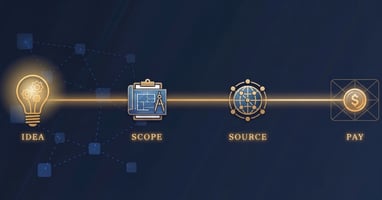
Idea-to-Pay is ORO's framework for the complete journey - from the moment an idea or need exists anywhere in the business, through every step of procurement, finance, compliance, and supplier engagement, all the way to payment.
It is a business user journey. Designed for everyone in the enterprise - anyone who needs to buy something, monitor risk, compliance or finance, or engage and manage suppliers— which is nearly everyone. It empowers them to get what they need without requiring them to memorize a process, understand procurement terminology, or know which team owns which step.
In practice, that means, in addition to the full range of purchasing requests, users can ask things that procurement software has never been able to handle before:
- How did someone else in my organization develop a similar program to X?
- What do contracts look like for service / deliverable X?
- What sort of total cost savings might I expect to achieve with this program I'm working on?
- What is the right order to engage suppliers for this project?
The result is adoption that happens more naturally - because ORO makes the journey from idea to payment easier, faster, and more intuitive than the workarounds legacy procurement processes created.
Every stage of the journey is connected:
- Idea - Submit your request through the ORO interface, Microsoft Teams, or Slack, in plain language, with no form expertise or procurement knowledge required.
- Route - ORO interprets your request, asks the right clarifying questions, and determines exactly where it needs to go and who needs to be involved.
- Resolve - Sourcing, contracting, approvals, and supplier onboarding happen mostly out of view, surfacing only for important exceptions, and with key procurement checkpoints.
- Pay - POs, invoice matching, and payment happen seamlessly - automated and orchestrated end-to-end, with no manual handoffs.
Procurement stays in control. Business users stay moving. And every step is captured, governed, and auditable.

What Idea-to-Pay Looks Like in Practice
At DPW New York, ORO's co-founders joined The Coca-Cola Company on the main stage to show the Idea-to-Pay journey running in production — from a marketing spend request, through supplier onboarding, approvals, and finance steps, all the way to a completed purchase order integrated directly with their ERP, across more than 200 countries.
Their program had a non-negotiable design principle from the start: no training required. They discarded traditional training manuals entirely, communicating the change through short videos and reels — meeting users where they already were rather than asking them to learn a new system. The result was a walk-up experience that worked globally from day one across every operating unit and for all indirect procurement spend.
On stage, they described the problem they set out to solve: "We were expecting our users to be the human integrator among the different systems and the different steps. It was practically impossible trying to teach them and train them — they were always missing something. And it was not their fault. It was just how we designed that experience, or maybe did not design that experience in the first place."
That’s the problem Idea-to-Pay solves. Not by training users harder. By designing the experience so that training isn't the answer.
Customers using the Idea-to-Pay framework are seeing results that reflect the scale of the architectural change. Global enterprises are achieving 85% user adoption across 20 countries in under two months. One leading pharmaceutical company reduced requester effort by 70% through agentic automation. Across the ORO customer base, supplier onboarding has been reduced to under five days, and individual agents are processing 15,000+ transactions per month. At the largest deployments, 38,000 users went live across 35+ countries in two weeks.
What Makes Idea-to-Pay Work
Delivering on this vision requires more than a better front-end interface. It requires a platform that understands procurement deeply enough to orchestrate it — across the full journey, across every connected system, without gaps.
The capability that makes the initial user experience possible is AskORO AI 2.0— ORO's AI-powered front door for any employee, any idea, any business intent. The keyword is "any." Earlier approaches to conversational AI in procurement pre-defined what users could ask. The system was smart within its lanes, but the lanes were fixed. Ask something the system wasn't built for, and you're back to square one.
AskORO AI 2.0 doesn’t work that way. ORO’s AI interprets intent — whatever form it arrives in — and determines how to respond: what clarifying questions to ask, what workflow to trigger, what information to gather. There is no fixed menu. There are no dead ends.
"It's a truly agentic approach to intent management. Nothing is hard-coded. ORO AI decides what research to do to guide you to the answer."
- Sudhir Bhojwani, CEO and Co-Founder, ORO Labs
In practice, that means users can ask things that procurement software has never been able to handle before:
- How did someone else in my organization develop a similar program to X?
- What do contracts look like for service / deliverable X?
- What sort of total cost savings might I expect to achieve with this program I'm working on?
- What is the right order to engage suppliers for this project?
Underneath that front door, the platform covers the full journey without handoff gaps:
-
Intake with AskORO AI: enables intake at the earliest, high-value “idea” stage of a business need; agentic intent-shaping and dynamic routing.
-
Sourcing: AI-generated RFx documents from natural language, bid collection and scenario analysis, and autonomous negotiations for price, payment, and delivery.
-
AI-Powered Contracting: Template management, clause risk identification/recommendations, metadata extraction, approvals management, signature orchestration, full repository.
-
Procurement Workflows: PR management from approved request to PO issuance directly in ERP; AP automation with AI 3-way match.
-
Supplier Management: onboarding, self-service supplier workflows with supplier front door.
-
Risk Workflows: TPRM including supplier assessments, certification management, and bank validation.
-
Agent Builder: In addition to 50+ out-of-the-box agents, customers can design or adapt, test, and maintain agents - with agent to agent communication - and deploy them across fully governed multi-agent workflows.
To make it all possible, behind that front door are these critical foundations:
- A procurement-native data model and knowledge graph, spanning up to five databases. This enables Agent-to-Agent connectivity with maximum context.
- Multi-Agent orchestration with AI Governance by design, embedded systemically in the architecture as well as in agentic guardrails and selective human-in-the-loop design to ensure data integrity, AI drift management, auditability and continuous improvement.
- Semantically deep, iPaaS powered integrations: Seamless augmentation of existing tools, S2P suites, and ERPs offers a lower-risk way to accelerate time-to agentic-value that protects existing technology investments and preserves optionality on longer-term platform decisions.
- Proven SDLC/ADLS processes.
- Services: Procurement-specific expertise including enterprise solution design, implementation, change management and customer success programs that provide structured support from pre-sales through adoption and scale up of multi-phased deployments.
The Shift Has Already Started. Are You Ready to Capture More Value?
Source-to-Pay starts when procurement is ready. Idea-to-Pay starts when the business has a need.
That is the shift. And it is the one that actually changes how procurement is experienced by the tens of thousands of people in any large enterprise who interact with it every day — most of whom would never describe what they're doing as "procurement" at all.
That is exactly the point.
Want to learn about how ORO can transform procurement at your organization? Book a demo with one of our experts.